
News & Events
| [GSIS Leaders Forum/GSIS 리더스포럼] Understanding Cultural and Arts Policy and Its Key Issues/문화예술정책의 이해와 이슈 | |||||
|---|---|---|---|---|---|
| 작성자 | 관리자 | 작성일 | 2026.10.27 | 조회수 | 120 |
| 첨부파일 | 그림1.png | ||||
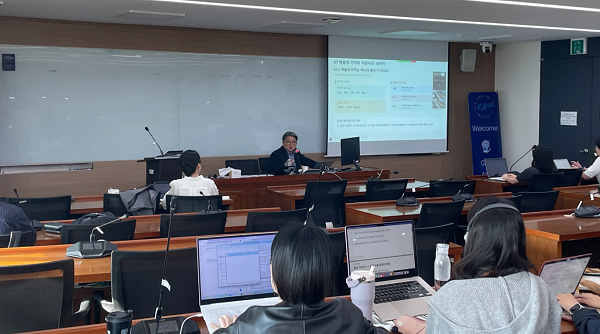
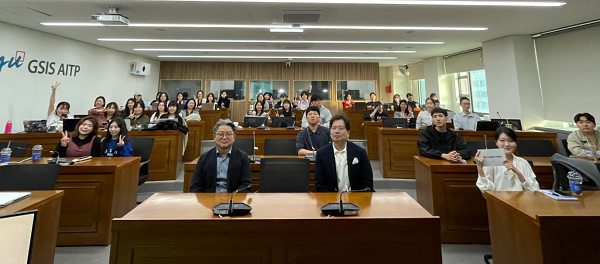 On October 16, at 3 p.m., a special lecture was held in Room 703,
Building 301, under the theme of “Understanding Cultural and Arts Policy and
Its Key Issues,” featuring Song Si-kyung, former Secretary-General of Arts
Council Korea (ARKO). Hosted by Professor Lee Jun-ho, of the Korean–English
track, approximately 40 second-year students from the Department of AITP
attended. 지난 10월 16일 (금) 오후 3시, 301관 703호에서 송시경 전 한국문화예술위원회 사무처장을 초청해 ‘문화예술정책의
이해와 이슈’를 주제로 특별 강연을 열었다. 이번 특강은
한·영 전공 이준호 교수 주관으로 개최되었으며, 전문통번역학과 2학년생 약 40명이 참석했다.
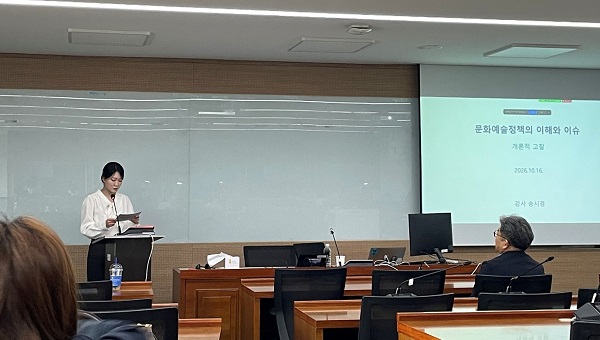
Song worked for 34 years at ARKO,
performing various tasks such as program support, venue management, and support
for artistic creation. Drawing on this experience and expertise, he explained
the institutional foundations of cultural policy and introduced today's major
issues in cultural and arts policy. 송시경 연사는 34년간 한국문화예술위원회에서 사업 지원, 공간 운영, 예술 창작 지원 등 다양한 업무를 수행하며 쌓은 현장 경험과 전문성을 바탕으로 문화 정책의 제도적 기반을 설명하고
오늘날 주요 문화예술정책 과제를 소개했다.
In the first part of his talk, he examined the definition of culture
and the arts from academic, practical, and international perspectives before
expanding the discussion to the definition and categories of cultural policy,
its main activities, and related areas. He introduced two key concepts of cultural
and arts policy: “democratization of culture” and “cultural democracy.” He then
explained the differences between the two concepts, the historical background
of Korean cultural and arts policy, and its characteristics. 1부에서는 학술적·실용적·국제적
관점에서 문화예술의 정의를 살펴보고, 문화정책의 정의 및 범주, 주요
활동 및 연계 범위 등으로 논의를 확장했다. 특히 문화예술정책의 핵심 개념인 ‘문화의 민주화’와 ‘문화민주주의’를 소개하고, 두 개념의 차이와 함께 한국 문화예술정책이 형성된 역사적
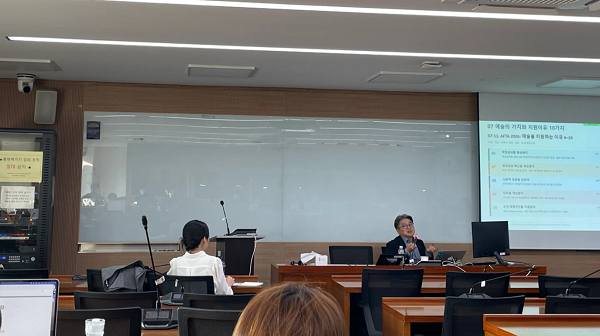
배경과 특징을 설명했다. In the second session, he outlined the concept and importance of the
“arm's length principle,” which refers to “support without interference.” He
also introduced major examples from different countries, institutional
mechanisms, and approaches to implementing related programs. He concluded the
lecture by explaining the role and funding sources of ARKO while highlighting
major trends and issues in cultural and arts policy both in Korea and abroad. 2부에서는 ‘지원은 하되 간섭은 하지 않는다’는 의미의 ‘팔길이 원칙(Arm’s
Length Principle)’을 중심으로 그 개념과 필요성을 살펴보고 각국의 주요 사례와 제도적 장치, 관련 사업의 추진 방향 등을 소개했다. 이어 한국문화예술위원회의
역할과 재원에 대해 설명하고 국내외 문화예술정책의 주요 흐름과 쟁점을 짚으며 강연을 마무리했다.
During the Q&A session, students asked how to become
interpreters and translators who remain essential in the AI era, just as
culture and the arts retain their unique value despite political and
technological upheaval. Song’s advice was to cultivate the unique capabilities
of human interpreters and translators, such as the ability to convey human
emotions, think deeply, and use specialized terminology. He also recommended
that students develop their understanding of and sensitivity to culture and the
arts by attending theatrical performances. 질의응답
시간에는 정치적·기술적 격변에도 불구하고 고유한 가치를 지니는 문화예술처럼 AI 시대에 꼭 필요한 통번역사 되기 위한 방법을 질문했고, 이에
송시경 연사는 인간의 감정을 전달하는 인간 통번역사의 고유한 능력, 깊이 있는 사고, 전문 용어의 사용 능력 등을 갖추는 것이 중요하다고 강조했다. 또한
학생들에게 연극 관람을 통해 문화예술에 대한 이해와 감수성을 개발할 것을 조언했다.
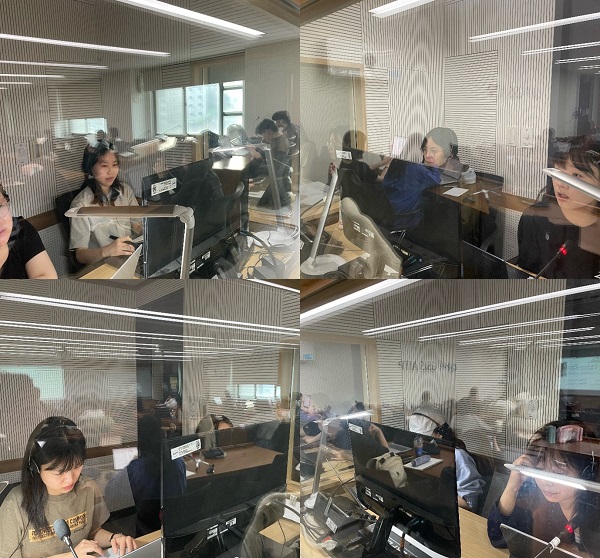
Meanwhile, this lecture was supported by simultaneous interpreting
provided by students from the Korean–English, Korean–Chinese, and
Korean–Russian tracks of the Department of AITP. 한편, 이번 특강에서는 전문통번역학과 한·영, 한·중, 한·러 전공 재학생들이 전공 언어로 동시통역을 지원했다. Reported by Lee Jimin, Korean–English
Major, Department of AITP
취재: 전문통번역학과 한·영 전공 이지민 |
|||||
GSIS office, Building 303, Room 708, GSIS, 84 HEUKSEOK-RO, DONGJAK-GU, SEOUL, 06974, KOREA
Tel : 02-820-5623, 5624, 6477 Fax : 02-827-0155 E-mail : gsis@cau.ac.kr
Copyrightⓒ Graduate School of International Studies, Chung Ang University. All rights reserved.
Tel : 02-820-5623, 5624, 6477 Fax : 02-827-0155 E-mail : gsis@cau.ac.kr
Copyrightⓒ Graduate School of International Studies, Chung Ang University. All rights reserved.